Ethics Is Not an Opinion: Why Quality Requires Leadership, Discipline, and Courage
- Charles Nadeau
- Feb 21
- 4 min read


Ethics is often discussed as a personal virtue, something internal, subjective, and shaped by experience. Quality, on the other hand, is frequently treated as procedural, external, documented, and audited. In practice, these two ideas are inseparable. In aerospace, ethics without quality is performative, and quality without ethical leadership is hollow.
The uncomfortable truth is this: ethics are only real when they are operationalized.
And in complex, high-risk organizations, quality is how ethics are made real.
The Illusion of Perceived Ethics
Many organizations believe they are ethical because they value integrity, transparency, or safety, at least in principle. Posters are printed. Values are stated. Expectations are articulated.
But ethics cannot live only in intent.
Perceived ethics emerge when leaders believe the organization is doing the right thing, even when signals suggest otherwise. Missed requirements are reframed as acceptable risk. Deviations become business decisions. Process erosion is justified by schedule pressure. Over time, ethics shift from a standard to a negotiation.
Quality is the antidote to perceived ethics.
Quality forces clarity where ambiguity is convenient. It demands evidence where assumptions feel easier. It converts values into requirements, requirements into processes, and processes into disciplined execution.
This is not bureaucratic behavior. It is moral behavior at scale.
Quality as Ethical Leadership in Action
In aerospace, quality is not a support function. It is a leadership function. It is how leaders demonstrate respect for the end user, the regulator, the operator, and the public.
Ethical leadership is not proven by good intentions. It is proven by decisions made under pressure.
Do we follow the process when it is inconvenient?
Do we stop work when data is insufficient?
Do we elevate concerns even when they threaten cost or schedule?
Do we hold ourselves accountable to the same standards we impose on others?
When leaders consistently choose process discipline over expedience, they are not being inflexible. They are being ethical.
Quality is how leadership makes ethics visible.
Responsibility Is Not Ambiguous, We Just Treat It That Way
One of the most damaging myths in organizations is that responsibility is shared but accountability is unclear. In reality, roles and responsibilities are usually well defined on paper. What is missing is ownership in practice.
Quality professionals often sit at the intersection of this failure.
They are expected to ensure compliance, safeguard product integrity, and manage risk, yet they are sometimes excluded from early decisions, late changes, or strategic conversations. When quality is treated as an after-the-fact validator instead of a first-order contributor, the organization creates ethical blind spots.
Knowing one’s responsibility within the organization is not about authority. It is about obligation.
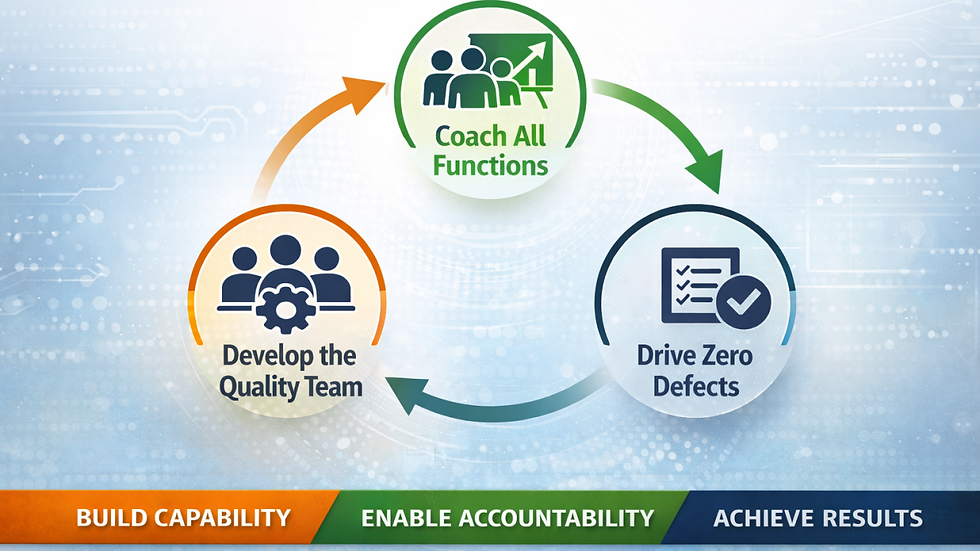
Quality professionals do not own production. They do not own engineering. They do not own supply chain. But they do own the integrity of the system that connects them.
And that responsibility does not disappear when it becomes uncomfortable.
Being Part of the Solution Is Not Passive
There is a persistent misconception that quality must choose between being compliant and being collaborative. This is a false choice.
Being part of the solution does not mean being quiet.
It does not mean softening requirements.
It does not mean absorbing risk so others can move faster.
It means understanding the intent of the requirement deeply enough to enable execution without erosion.
Quality professionals must be translators of intent, not just enforcers of rules. But translation requires mastery.
The Obligation to Be the Most Knowledgeable in the Room
In aerospace, quality credibility is earned through expertise, not position.
Quality leaders and professionals must strive to be the most knowledgeable voices in the room on matters of regulatory intent, process capability, risk pathways, failure modes, configuration control, change management, and verification rigor.
This is not about dominance. It is about stewardship.
When quality professionals lack technical depth or process fluency, their influence weakens. When they hesitate to speak, gaps widen. When they defer under pressure, discipline erodes.
Being vocal is not insubordination.
Driving discipline is not obstruction.
Insisting on process adherence is not resistance to business. It is the business.
Why Quality Mindset Must Start at the Top
A quality mindset cannot be delegated.
Organizations do not rise to the level of their procedures. They fall to the level of their leadership discipline. If leaders tolerate shortcuts, the system will normalize them. If leaders treat quality as a cost center, the organization will treat it as expendable. If leaders bypass process when convenient, others will do the same, only with less visibility.
Process discipline is a leadership behavior before it is an organizational one.
When executives model adherence, escalation, and accountability, quality becomes cultural. When they do not, quality becomes performative.
Making It Happen, With Integrity
Execution and ethics are not in tension. Poor execution is unethical. Incomplete execution is unethical. Undisciplined execution is unethical.
Making it happen does not mean making exceptions. It means making the system work as designed, or improving it when it does not.
Quality professionals are not there to slow organizations down. They are there to prevent organizations from drifting into ethical ambiguity disguised as efficiency.
In aerospace, quality is not about perfection. It is about responsibility.
And responsibility, clearly understood, courageously exercised, and consistently modeled, is the highest form of leadership.


Comments