Leading by Example: Scaling Quality Through Coaching and Accountability

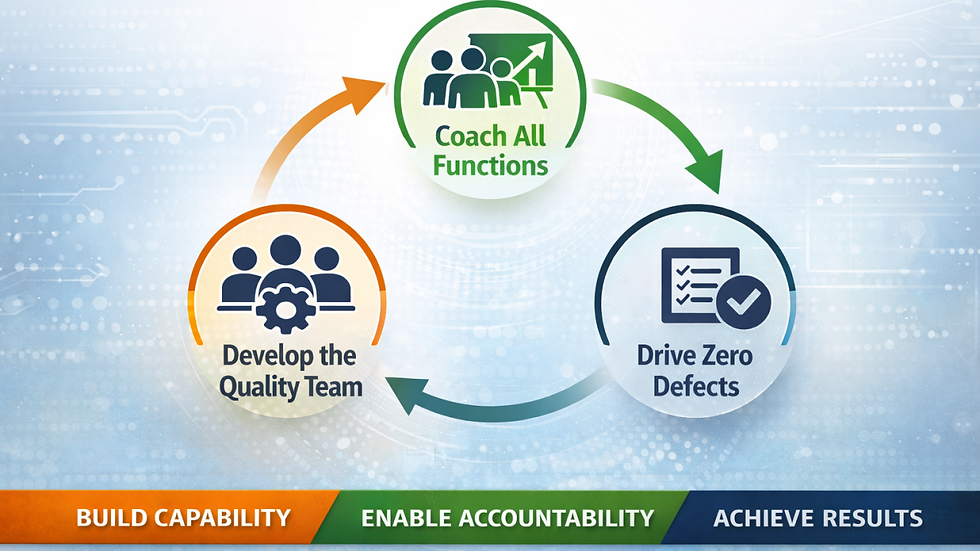
Building Organizational Capability Through Quality Leadership
Quality leadership is not defined by position or reporting structure. It is demonstrated through the ability to develop people, strengthen systems, and coach the organization to own quality at every level. In regulated and high-consequence industries, the strongest quality leaders are those who build capability across functions, not dependency on the quality team.
Quality organizations do not rely on inspection or escalation alone. They succeed because leaders invest in developing the skills, judgment, and discipline required for teams to lead quality within their own work.
Quality Team Development Is a Force Multiplier
The role of the quality function is evolving. It is no longer enough to manage compliance, audits, and findings. The most effective quality teams act as coaches, teachers, and system thinkers who elevate performance across the organization.
Strong quality leaders:
Develop their teams to understand and teach the quality management system
Build confidence in problem solving and risk-based thinking
Enable others to own quality rather than rely on quality to enforce it
When the quality team is developed well, the entire organization benefits.
Coaching Across Functions Builds Real Accountability
Organizational accountability is strongest when ownership lives where the work is done. Quality leaders help make this possible by coaching engineering, operations, supply chain, and leadership teams on how quality is built into their decisions.
This includes:
Helping teams understand how their processes impact safety and reliability
Clarifying roles, responsibilities, and decision authority
Reinforcing disciplined execution against defined processes
Accountability is not imposed. It is enabled through understanding, clarity, and consistent leadership behavior.
Quality Systems Enable Ownership, Not Control
A quality management system is most effective when it is understood, respected, and used as a decision-making framework.
Quality leaders who know the system well are able to:
Coach others on how processes are defined and improved
Identify variation early and address it constructively
Use the system to support decisions under pressure
When teams understand the system, quality becomes part of how work is done rather than something checked afterward.
Continuous Improvement Is How Leaders Teach Ownership
Continuous improvement is one of the most powerful coaching tools available to quality leaders. It creates a structured way for teams to learn, improve, and take responsibility for outcomes.
Effective quality leaders:
Coach teams to solve problems at the root cause level
Use data to learn and improve rather than to assign fault
Reinforce learning cycles that strengthen the system
This approach builds confidence, accountability, and long-term performance.
Leadership Without Authority Is a Core Quality Skill
Quality leaders often influence outcomes without direct authority. Their effectiveness depends on credibility, trust, and a strong command of the quality craft.
Leaders who develop these skills are able to:
Translate quality and risk into business impact
Align cross-functional teams around shared responsibility
Coach leaders at all levels through complex decisions
This is how quality leadership scales beyond the quality function.
Driving Quality and Zero Defects at Every Level
Quality cannot be inspected into a product. It must be built into process definition, execution, and verification at every stage.
Quality leaders reinforce:
Clear process ownership
Standardized execution
Disciplined verification
A zero defects mindset is achieved when leaders coach teams to reduce variation, follow defined processes, and continuously improve how work is done. Safe and reliable products are the result of unwavering discipline applied consistently across the organization.
A Practical Call to Action for Quality Leaders
Leaders who want to strengthen quality and accountability across the organization can start with three commitments.
First, develop your quality team as coaches and system leaders. Ensure they can teach, influence, and enable others, not just enforce requirements.
Second, coach all functions on their role in quality. Help teams understand how their decisions affect safety, reliability, and compliance.
Third, model disciplined execution daily. Use the system, reinforce learning, and address gaps consistently and constructively.
When quality leaders focus on developing people and systems, accountability becomes shared and performance becomes sustainable.
Closing Thought
The strongest quality organizations are built by leaders who invest in development, coach across functions, and model disciplined execution. Quality scales when knowledge, ownership, and accountability are embedded throughout the organization.
Quality does not grow through inspection alone. It grows through leaders who develop others to lead quality within their own world.


Comments